Long before Amazon revolutionized world commerce with its hyper-efficient distribution centers, a network of barefoot merchants in 14th-century Korea had already mastered the art of decentralized logistics.
In modern global commerce, logistics is destiny. Companies like Amazon and Alibaba dominate global markets not merely because they possess vast inventories, but because they built an invisible web of data and fulfillment networks that place products at a consumer’s doorstep in record time. Today, South Korea is globally renowned for its near-telepathic e-commerce delivery systems, where goods ordered at midnight arrive before dawn. This unrivaled logistical infrastructure is not an overnight modern miracle; it is a manifestation of an ancient economic DNA carried by Joseon’s unique merchant class: the Bobusang (Peddlers).
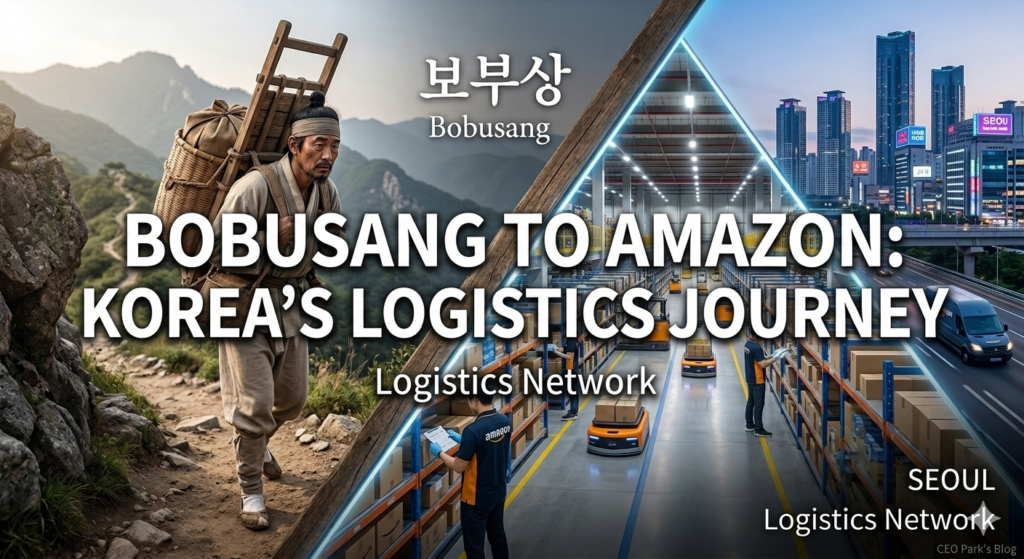
1. Bobusang: The Living Nodes of a Human Network
During the Joseon Dynasty (1392–1910), Korea’s mountainous geography and strictly regulated infrastructure made large-scale transport exceptionally difficult. There were no grand paved highways or massive shipping canals. To bridge the gap between rural producers and urban consumers, a resilient class of itinerant traders emerged. Divided into Bosang (packmen carrying delicate, high-value goods like silk and jewelry) and Busang (handicraft vendors carrying bulkier daily necessities like salt and pottery), they traveled entirely on foot, traversing rugged mountain passes with heavy wooden A-frame backpacks.
What made them a precursor to modern tech logistics was not just their physical endurance, but their tight organizational architecture. The Bobusang operated like a highly structured guild. They shared real-time market intelligence across different regions, established strict codes of commercial ethics, and created standardized pricing. They were, in essence, the living, breathing data nodes of an early nationwide supply chain.
2. The Five-Day Market Loop: An Analogue Multi-Echelon System
Modern supply chain management relies on “Multi-Echelon” distribution—a system where central hubs feed regional fulfillment centers, which then route products to local sorting facilities. Joseon’s Bobusang synchronized a remarkably similar network through the Oilsjang (Five-Day Market system).
Instead of setting up permanent brick-and-mortar storefronts, markets rotated across different villages every five days. The Bobusang calculated these shifting market schedules with mathematical precision. They timed their physical journeys so that as one market closed, they arrived at the next with exactly the goods that local population lacked. By continually moving inventory across a rotating network of local hubs, they prevented regional supply shortages and stabilized prices—mirroring the predictive inventory placement algorithms that Amazon uses to stock its regional warehouses today.
3. The DNA of Trust and Last-Mile Delivery
In the tech sector, the hardest part of logistics to optimize is the “last mile”—the final, most expensive leg of a product’s journey from a local hub to the consumer’s hands. Success in the last mile ultimately depends on absolute trust and local execution.
For centuries, the Bobusang were the absolute masters of the last mile. Operating under strict internal laws that severely punished theft or consumer deception, they became a trusted institution. Rural villages relied on them not only for physical commodities, but as reliable couriers of news, financial transactions, and essential information. This historical emphasis on absolute execution and hyper-local trust laid the cultural groundwork for Korea’s modern corporate culture, paving the way for today’s hyper-fast e-commerce delivery networks.
Conclusion: Honoring the Invisible Architects
When global tech giants compete to shave minutes off their delivery times using drones and automated rovers, it is worth remembering that the core principles of great logistics remain unchanged: connecting people, anticipating demand, and building unshakeable trust across a resilient network. Korea’s modern status as an unstoppable e-commerce powerhouse was written centuries ago by the sweat and footprints of the Bobusang. They proved that even when resources are sparse and geography is unforgiving, human ingenuity can build an empire out of footsteps alone.