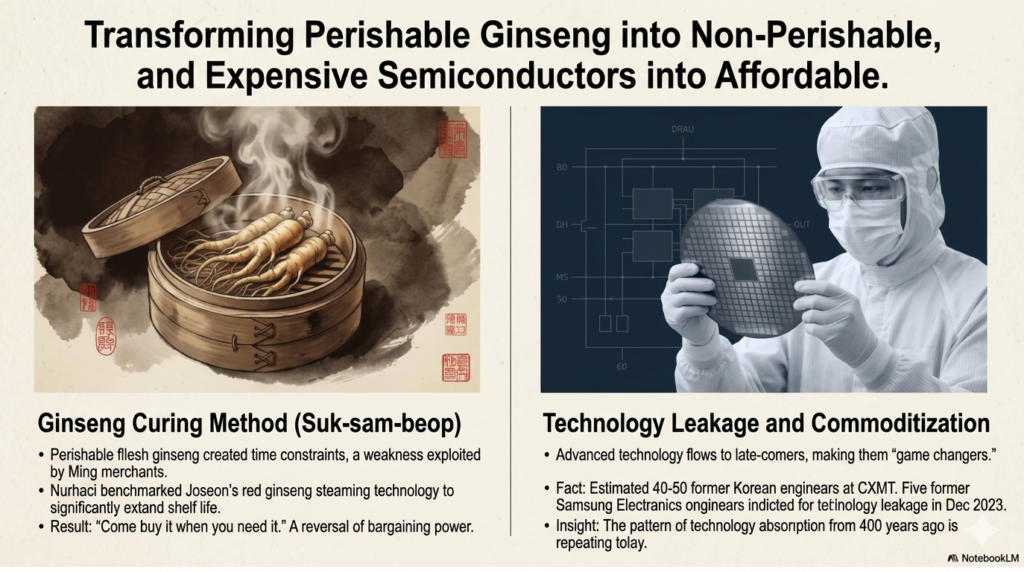
Two historic miracles expanded Korea’s economic frontiers: Joseon’s ginseng and modern semiconductors. Remarkably, they share the exact same DNA.
Korea’s hyper-speed growth, often hailed as the “Miracle on the Han River,” is widely credited to the success of its semiconductor industry in the late 20th century. However, looking deeper into the nation’s history reveals that even in times of extreme scarcity—devoid of technology and natural resources—Korea already possessed the unique cultural DNA to dominate global markets through sheer human ingenuity and unparalleled quality. That historical equivalent to the modern semiconductor was Joseon’s ‘Ginseng.’
1. A Triumph of Technology Over Harsh Environments
Semiconductors are created by extracting silicon from sand and applying ultra-precise engineering. It is an industry that generates massive added value out of virtually nothing, relying purely on human intellect and technological prowess.
Joseon’s ginseng followed the exact same trajectory. As wild ginseng neared depletion, the people of Joseon invented ‘Gasam’ (domesticated ginseng)—the world’s very first artificial cultivation technique. Controlling sunlight with sophisticated shading structures and managing soil moisture required the pinnacle of agricultural science at the time. By turning barren land into a source of world-class premium value through technology, ginseng served as the semiconductor of the Joseon era.
2. Shaking Up the Global Market with Exclusive Dominance
Today, Korean-made memory chips are an indispensable component of global tech infrastructure, dictating market trends. Centuries ago, Joseon’s ‘Hongsam’ (red ginseng, steamed and dried) was the ultimate high-tech export that captivated the Qing Dynasty, Japan, and Southeast Asia.
Through its exclusive processing technology, Joseon dramatically extended the shelf life of red ginseng and amassed vast amounts of silver through international trade. The historical sight of Qing emperors and nobles lining up to secure Joseon’s red ginseng mirrors today’s reality, where global big tech giants scramble to secure Korea’s latest high-bandwidth memory chips.
3. The DNA of Turning Crisis into Opportunity
A shared spirit connects the success of artificial ginseng cultivation to the semiconductor miracle: the bold entrepreneurship to pave a path through crisis. The merchants of Gaeseong who researched cultivation techniques when wild ginseng was disappearing share the exact same mindset as the mid-20th-century Korean entrepreneurs who risked everything to invest in semiconductors, defying a skeptical world that openly doubted Korea’s capabilities.
Conclusion: Toward a New Silicon Road
Just as Joseon ginseng endured harsh climates to produce its unrivaled, nutrient-rich saponins, Korean semiconductors have defended their global number-one position through countless economic crises. Possessing limited land and scarce resources, but rising to the top of the world through ‘people’ and ‘technology’—this is the true core competitiveness of Korea, stretching from Joseon’s ginseng directly to modern silicon.