
How Kimbap Captured Global Appetites: From Ancient Roots to the Food Revolution Rivaling the Hamburger
“Korea’s finest convenient meal evolves into the world’s trendiest wellness dish.” Much like how the hamburger fueled the industrial growth of the West in the past, Kimbap has emerged in the modern global market as the ultimate balanced meal for busy individuals. This report analyzes its history, nutritional value, and unique market differentiation.
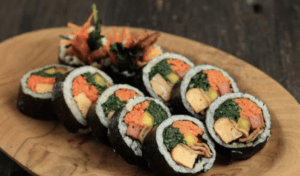
1. Origins and History: The Evolution of Korea’s Ancient Wrapping Culture
Recently, a distinct Korean dish has been dominating supermarket freezers worldwide and reshaping lunch hour routines in major metropolitan centers like New York. This culinary phenomenon is Kimbap. To fully comprehend why this convenient roll is capturing global attention, one must explore the deep roots of Korean food culture.
Wrapping rice in various edible leaves or seaweed, known as Ssam, has been an integral part of Korean daily life for centuries. Historical documentation reveals that wrapping rice in seaweed dates back to ancient times. In Samguk Yusa (Memorabilia of the Three Kingdoms), records show a tradition where people wrapped rice in seaweed or cabbage leaves during the first full moon of the lunar year to pray for a bountiful harvest. Furthermore, the Joseon Dynasty geographical text Dongguk Yeoji Seungram explicitly notes that sea mustard and seaweed were cultivated and presented as royal tributes.
By the late 19th century, the classic cookbook Siui Jeonseo detailed an early blueprint for processing seaweed by spreading rice flat over it and rolling it carefully. While the modern format adopted some rolling tools and structural elements during the early 20th century, Kimbap established its own unique culinary identity. Instead of seasoning the rice with vinegar, Korean Kimbap utilizes a generous blend of savory sesame oil and salt to maximize its rich, earthy flavor. Today’s Kimbap stands as a magnificent heritage product combining ancient culinary practices with modern utility.
2. Kimbap vs. Japanese Sushi: Distinct Identities in Global Gastronomy
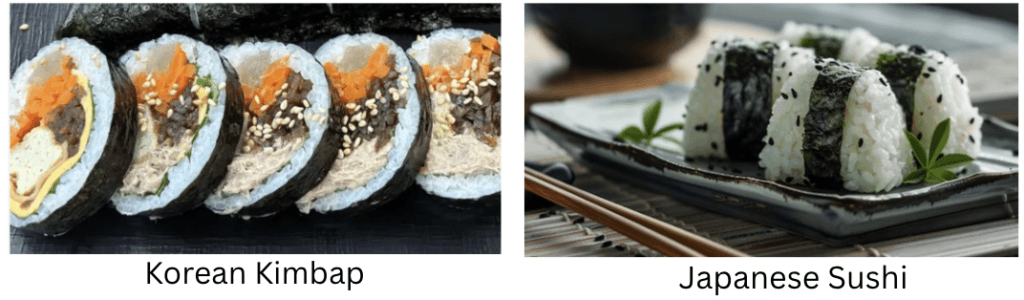
When Western consumers first encounter Kimbap, they frequently mistake it for Japanese sushi rolls (specifically Makizushi). Although the outward appearance—rice wrapped in a dark sheet of dried seaweed and sliced into rounds—seems identical, these two dishes stem from completely different culinary philosophies, flavor targets, and core ingredients.
The most definitive distinction lies in the seasoning of the rice. Japanese sushi seasons the grains with a mixture of vinegar, sugar, and salt (known as Tezu or Shari) to create a sharp, acidic, and sweet profile. Conversely, Korean Kimbap seasons the rice strictly with salt and sesame oil, offering a deeply savory, nutty, and comforting aromatic foundation. This alters the immediate sensory experience from the very first bite.
Furthermore, the composition and preparation of the inner fillings vary dramatically. Sushi rolls predominantly focus on raw fish (like tuna or salmon) or pickled elements paired with avocado, designed to be dipped in soy sauce. Kimbap, however, features a dense medley of fully cooked and seasoned components: sautéed carrots, spinach, braised burdock root, egg garnishes, pickled radish, and grilled meats. Because each ingredient is prepared independently, Kimbap delivers a robust, self-contained flavor harmony without requiring any dipping sauce. While sushi celebrates the raw freshness of seafood against vinegar, Kimbap champions a vibrant orchestra of warm, cooked ingredients.
3. The Power of Seaweed: Nutritional Balance in a Single Roll
In an era where health-conscious diets dominate global market trends, Kimbap receives exceptionally high praise for its impeccable nutritional architecture. While many Western fast-food options are loaded with refined sugars, trans fats, and excess sodium that contribute to metabolic disorders, a single roll of Kimbap provides a complete, low-calorie distribution of macronutrients and vitamins.
The outer wrapper, dried seaweed (Gim), is celebrated by nutritionists as a marine superfood. Just five sheets of high-quality dried seaweed contain protein equivalent to a whole egg. It is also packed with beta-carotene, which converts to Vitamin A to boost immunity and protect vision, alongside significant amounts of dietary fiber and taurine, which help clear blood vessels and manage cholesterol levels.
By anchoring the dish with a controlled layer of rice and filling the interior with lean proteins (eggs, beef, or tuna) and nutrient-dense vegetables (carrots, burdock, spinach), Kimbap helps prevent drastic blood sugar spikes. Because the ingredients are blanched or lightly sautéed rather than deep-fried, it maintains an optimal caloric profile, making it a premier dietary asset for anyone seeking effective weight management without sacrificing nourishment.
4. Parallel to the American Hamburger: The Efficiency Revolution
Analyzing Kimbap’s rise reveals a historical parallel to the birth and mass expansion of the American hamburger during the late 19th and early 20th centuries. As urbanization and industrial factory shifts accelerated in the United States, busy workers no longer had the luxury of long, formal meals using silver utensils. The hamburger solved this crisis by placing beef patties and vegetables between bread, allowing individuals to consume essential calories with one hand while on the move.
Modern global professionals operate under similarly demanding, fast-paced schedules. Kimbap addresses this modern reality seamlessly. It is served pre-sliced into bite-sized rounds, making it a superior finger food that can be consumed at a desk, during a commute, or between meetings without making a mess. It captures the exact convenience that once made the hamburger a global staple, but replaces refined flour and heavy grease with wholesome rice and fresh vegetables. Kimbap effectively occupies a unique global market niche: fast-food convenience delivered through a nutritious, slow-food assembly.
5. Conclusion: Why the Global Market is Embracing Kimbap
The ongoing international enthusiasm for Kimbap is driven by multiple factors. High exposure across media platforms—including Korean dramas and viral social media trends—initially triggered consumer curiosity. Short-form video platforms amplified this momentum further, turning frozen Kimbap reviews into instant supply shortages at major retail chains. However, its long-term integration into mainstream eating habits relies on its intrinsic vegan-friendliness and customizable versatility.